The Geometry of Injustice

On majoritarianism, the ghost of Jinnah, and the philosophical foundations of a democracy that counts some votes more than others

John Locke, writing in his Second Treatise of Government in 1689, proposed a deceptively simple compact: that legitimate political authority derives not from the divine right of kings nor from the brute fact of military conquest, but from the consent of the governed, each individual surrendering a portion of natural liberty to a commonwealth in exchange for the protection of life, liberty, and property. The operative word, so easily passed over, is each. Not some. Not the majority. Each. The social contract, for Locke, was universal in its application, or it was nothing at all. It was a covenant, not a calculation.

Three hundred and thirty-seven years after Locke set down his quill, the results of the Assam Assembly election 2026 invite us to revisit his compact, not to celebrate it, but to measure how far the world’s largest democracy has drifted from its philosophical foundations. The numbers, examined without sentiment, produce a conclusion that is both arithmetically precise and morally uncomfortable: in Assam, not all votes are equal. Some votes, it turns out, are considerably more equal than others.

I. The Mathematics of Unequal Citizenship

The facts are not disputed. Assam’s 126 assembly constituencies were redrawn in 2023 following the first delimitation exercise in nearly five decades. The stated purpose was equity: to bring constituency sizes in line with population realities. The outcome, examined constituency by constituency, suggests something more complex and considerably less equitable.
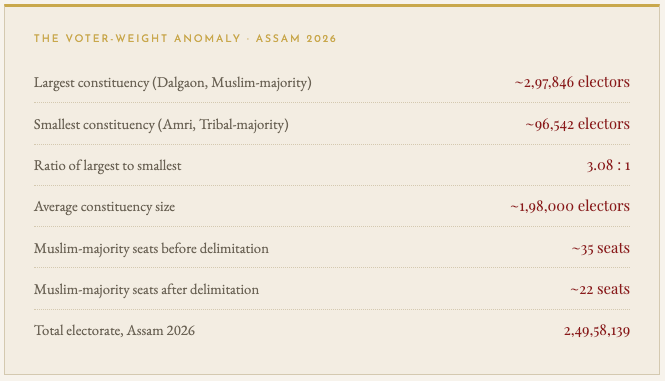
A voter in Amri, therefore, wields three times the political weight of a voter in Dalgaon. Their representative speaks for 96,000 people; the Dalgaon MLA speaks for nearly three times that number. Locke’s each has been quietly replaced by a sliding scale. And the sliding scale, it is worth noting, does not slide randomly. It slides in a very particular direction: downward for constituencies where Muslims form the majority and upward for constituencies where they do not.
II. The Satirist’s Irony: Jinnah Was Right

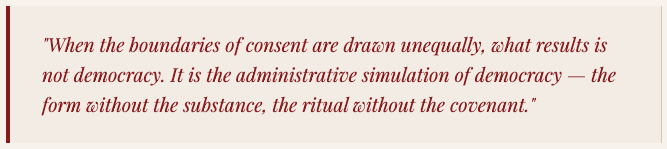
It is one of history’s more exquisite ironies, the kind that would have delighted Voltaire and appalled Nehru, that the data produced by the 2026 Assam election constitutes, if one squints at it from a certain angle, a retrospective vindication of Mohammed Ali Jinnah.

Jinnah’s central argument, the one that sundered the subcontinent and cost a million lives, was this: that in a democracy defined by simple majority rule, a Muslim minority could never be structurally secure. That the arithmetic of Hindu numerical superiority would, over time and through entirely legal and democratic mechanisms, translate into the permanent political subordination of Muslim citizens. He did not argue that Hindus were evil. He argued that majorities, given sufficient institutional power and sufficient motivation, tend to use that power in the interests of majorities. He called this structural inevitability. He called it the reason for Pakistan.

The liberal consensus of independent India rejected this argument with contempt. It was communal. It was cynical. It was the reasoning of a man who preferred partition to the patience required by pluralism. Ambedkar’s India was to be different—secular, constitutional, and blind to religion in the distribution of political rights.

And yet here we are, seventy-eight years later, in a state where the delimitation exercise has reduced Muslim-majority seats from thirty-five to twenty-two, where the largest electorates cluster in Muslim-majority constituencies and the smallest in Hindu and tribal ones, and where a cabinet minister campaigned in Barpeta by stating openly that the boundaries had been drawn to ensure that “miyas” could not win the seat—and won. Jinnah, one imagines, would not have been surprised. He would merely have noted, with the thin satisfaction of the vindicated prophet, that he had said as much.
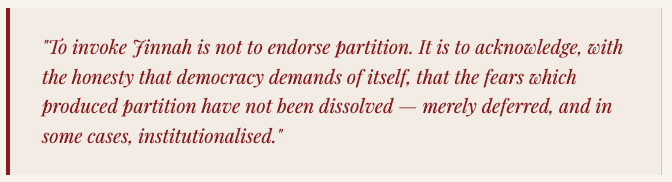
Let us be precise about what is being said here, because precision matters in philosophy as it does in electoral arithmetic. This is not an argument for Pakistan. It is not an argument that Jinnah’s solution was correct. The partition was a catastrophe. The two-nation theory was morally bankrupt. These things remain true.

What is being said is narrower and more uncomfortable: that Jinnah’s diagnosis—not his prescription—has found its evidence in the constituency maps of Assam, 2026. That a democracy that consistently arranges its institutions to dilute the political weight of a minority has ceased, in the Lockean sense, to be a democracy at all.

III. Majoritarianism Is Not Democracy

This distinction between democracy and majoritarianism is one that political philosophers have been drawing with increasing urgency since at least Alexis de Tocqueville, who warned in 1835 of the “tyranny of the majority” as democracy’s most seductive and most dangerous internal corruption. De Tocqueville was writing about the United States of America and its treatment of Black citizens—a context not entirely without resonance for our purposes. His insight was that a system in which fifty-one percent of the population can legally, procedurally, and with full democratic sanction systematically disadvantage the remaining forty-nine percent is not a free society. It is an elective despotism.

John Stuart Mill, writing a generation later, was more precise still. In Considerations on Representative Government (1861), Mill argued that a genuine democracy requires not merely that majorities prevail, but that minorities are represented—that their voices reach the legislature in proportion to their numbers, that their interests are heard, and that the system does not structurally exclude them from political power. A system that fails this test is, in Mill’s formulation, not representative government. It is a majority government—a meaningfully different and considerably lesser thing.

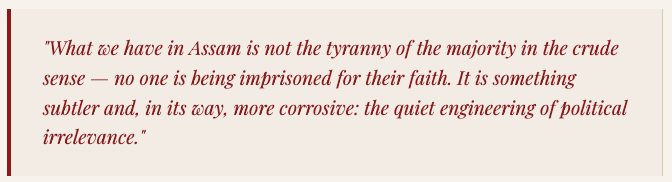
The Assam data meets Mill’s test for majority government with uncomfortable precision. Of the twenty-two seats that Congress won in 2026, all but one are constituencies with Muslim voter pluralities. The party that claims to represent pluralism, secularism, and inclusive nationhood is, in effect, the party of Muslim constituencies—because the delimitation and its consequences have made winning Hindu-majority seats structurally improbable for any non-BJP formation. The political landscape has been sorted, constituency by constituency, into two almost hermetically separate worlds.
IV. The Philosophical Case for Hope

And yet. And yet.

The same philosophical tradition that furnishes our critique also furnishes our reason for hope; and it would be a philosophical dereliction to invoke Locke and Mill only in accusation without also invoking them in aspiration.

Locke’s social contract was not a description of what governments are. It was a prescription for what they ought to be — and, crucially, a theory of what happens when they fail. When a government violates the compact, when it ceases to protect the natural rights of all it governs, the people retain what Locke called the “right of revolution”—not necessarily violent revolution, but the right to withdraw consent, to reconstitute authority, and to demand a more perfect covenant. In constitutional democracies, this right is exercised through courts, through civil society, through journalism, and through the slow accumulation of moral pressure on institutions.

India’s Supreme Court has, in the past, demonstrated a capacity for structural intervention in electoral matters that most constitutional courts would envy. The very delimitation exercise under scrutiny was supervised by the Election Commission: an institution whose independence, though tested in recent years, remains constitutionally guaranteed and civically defended. The data we have examined in this essay is public. It is being written about, argued over, and contested. That contestation is itself a form of democratic life.

Amartya Sen, India’s greatest living contribution to political philosophy, has argued throughout his career that democracy is not merely a mechanism for aggregating preferences—it is a practice of public reasoning. A society that reasons publicly about its own injustices, that names them, measures them, and argues about them, has not abandoned the democratic project. It is, in Sen’s formulation, engaged in its most essential activity.

The voters of Assam—all of them, Hindu and Muslim, Assamese and Bengali, tribal and plains-dweller—deserve a system in which their franchise carries equal weight. That is not a partisan demand. It is not a Congress demand or a BJP demand. It is a Lockean demand, a Millian demand, a human demand, and a fair and equitable demand that flows from the first principles of the political philosophy on which the Indian Constitution was constructed and democracy itself rests.

“India did not choose democracy because it was expedient. It chose democracy because it believed, with Locke, that legitimate authority can only rest on equal consent. That belief has not been repealed. It has merely been tested.”
The ghost of Jinnah should not be allowed the last word in a conversation about India’s democracy. He was right about the danger. He was catastrophically wrong about the remedy. The remedy—the only remedy that does not cost a million lives—is the patient, stubborn insistence on the equal political weight of every citizen, regardless of which side of a redrawn boundary line they happen to live on.

Assam’s rivers have been bridged. Its roads have been built. Its economy has grown. These things are real, and they matter. But a state whose largest constituencies are three times the size of its smallest, whose delimitation reduces minority representation by a third, and whose cabinet ministers campaign openly on the exclusion of communities from political power has a bridge yet to build—one that no chief minister’s inauguration speech will suffice for.

It is the bridge between the India that exists and the India that Locke, Ambedkar, and Patel—and yes, even the India that Jinnah feared would never come—would recognize as worthy of the name democracy.

That bridge is not impossible. It is merely unbuilt. And in a democracy, the unbuilt is always still only a matter of political will and public understanding. The status quo can only be sustained by an unbothered or brainwashed citizenry.

Note: The views expressed invoke the philosophical traditions of Locke, Mill, de Tocqueville, and Sen in the service of democratic accountability and not partisan advantage.

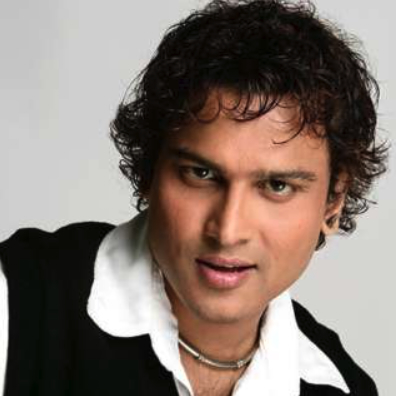
The True Memorial: Transmuting Grief into the Gospel of Garg

The death of an icon, especially one as fundamentally defiant as Zubeen Garg, precipitates not merely a wave of national mourning, but a spectacle of collective self-deception. It is a moment where a populace, long accustomed to the comfortable numbness of political apathy and cultural compromise, briefly mistakes genuine sorrow for meaningful virtue. Across the length and breadth of the Brahmaputra Valley, the tears have flowed—genuine, perhaps, but ultimately cheap. The social media tributes, the eulogies delivered by talking heads who spent Zubeen’s living years dismissing him as unruly or radical, and the sudden, performative embrace of his most challenging, anti-establishment lyrics, all constitute a fraud. This is not respect; it is the comfortable, post-mortem adoration afforded to a dead lion, safely defanged and reduced to a sentimental commodity. The question that must pierce this thick, suffocating veil of sentimentality is brutally simple: What is the philosophical and political price of these tears, and what becomes of the nation when the convenient mourning ceases?

The death of a revolutionary conscience like Garg must not be permitted to dissolve into the sweet, nostalgic syrup of remembrance. That is the final, subtle victory of the mediocrity he fought: to have the sharp edges of his life rounded off by the sands of a mournful apathy. If the Assamese nation, which claims him now in his absence with such desperate possessiveness, allows his legacy to become just another festival, another anniversary, another conveniently consumable narrative—then every tear shed is a tear of hypocrisy, and every tribute a betrayal. The true memorial, the only one worthy of his staggering, refreshingly raw yet reckless integrity, demands an immediate, seismic shift from passive grief to the perilous, uncompromising emulation of his life and principles. Once the ashes cool, the real work—the work of dangerous, discomforting imitation—must begin.

The Anatomy of a Martyr and the Fraud of Post-Mortem Adoration

The first and most immediate betrayal is the rush by the political establishment to sanitize, claim, and ultimately neutralize the man who lived to challenge their very legitimacy. Observe the convenient amnesia: the political figures and cultural gatekeepers who, in life, found his voice too loud, his principles too rigid, his questions too inconvenient, now stand on platforms draped in black, pontificating on his “immense contribution.” It is an intellectual obscenity. They are celebrating a statue while having vehemently opposed the man who carved it. This sudden conversion is not a sign of respect for Garg; it is a desperate attempt to launder their own political complicity in the very system he sought to dismantle. They honor the dead rebel because the dead rebel is silent, safely embalmed in history and incapable of demanding accountability for the next injustice and even the injustice of his untimely demise.

This phenomenon is the philosophical cowardice of the collective made manifest. It is easy, even fashionable, to venerate a dead man’s defiance; it requires no personal risk, no uncomfortable conversations, and no forfeiture of commercial or political interests. The true test of a society’s character is not how it mourns its heroes, but how it treats its living prophets—the ones who shatter the consensus, who point the finger at comfortable corruption, who refuse to allow art to serve as the velvet soundtrack to venality.

Zubeen Garg was, in life, a persistent, throbbing migraine for the status quo. In death, they attempt to turn him into a pleasant lullaby. We, the collective inheritors of his rage and his art, must ruthlessly refuse to sing that tune. The measure of our respect must be gauged by our willingness to continue the fight he started, even if that means making ourselves as socially awkward, commercially unviable, and politically targeted as he often was.

The Gospel of Garg: Uncompromised Artistry and the Rejection of the Marketplace

Zubeen Garg’s first, most profound principle was the uncompromising sanctity of his art. He never treated music as a mere transaction, a comfortable commodity to be sold by the pound in the bazaar of popular taste. His discography is not just a collection of hits; it is a sprawling, often contradictory, frequently chaotic diary of a soul grappling with its environment, refusing to separate the personal lyric from the political slogan. He rejected the sleek, soulless homogenization that defines much of modern, commercial culture. His music retained a necessary, vital rawness—a deliberate refusal to polish away the inconvenient truths that made it resonate with the common man’s struggle.

This is the principle the Assamese nation must emulate, not just in its art, but in its every endeavor. The market, the great homogenizer, demands that everything be soft, palatable, easily digested, and devoid of sharp edges. It rewards those who sing of trivial, universalized romance while the state of the culture decays around them. Garg, by contrast, insisted that art must be dangerous, that it must demand something of the listener, that it must be capable of causing offence if the truth required it. The greatest disrespect to his memory is the proliferation of culture that serves only as distraction, as aesthetic wallpaper for a nation asleep. We must demand integrity, not merely in the songs we listen to, but in the journalism we consume, the policies we accept, and the cultural products we allow to define our identity. If the next generation of Assamese art is merely an imitation of a pan-Indian, commercial template, devoid of the grit, the dialectical complexity, and the unapologetic regionality that defined Garg’s work, then our nation has already forfeited its claim to his legacy.

The philosophical danger in our current moment lies precisely in the blurring of lines between authentic expression and manufactured content. When leaders lie preposterously—when truth is declared an “optional accessory to power,” as the current global trend dictates—the only true resistance comes from the artist who holds a mirror up to the rot and refuses to flinch. Garg did this with an almost reckless abandon. He sang in a voice that was unpolished, often raw, sometimes deliberately provocative, because the truth he carried was unpolished and provocative. Emulating him means rejecting the seductive comfort of silence, even when silence offers financial security or social approval. It means choosing the difficult, discordant chord of truth over the sweet, synthetic major key of collective delusion.

The Rhetoric of the Unbroken Voice: Truth, Power, and the Political Mandate

Zubeen Garg was not a politician, yet his life was a profoundly political act. He was the perpetual outlier, the voice that refused to be co-opted, lending his massive cultural capital not to endorsements or appeasement, but to causes that were profoundly inconvenient for the powerful. From the furious, definitive stand against the Citizenship Amendment Act (CAA), where he was one of the few celebrities to risk everything, to his environmental activism and his championing of social justice issues, his commitment was never conditional, and absolutely never transactional. He was the necessary counter-rhetoric to the rising tide of political mendacity and manufactured consent.

And yet, here is the paradox that indicts my nation: millions loved his defiance, cheered his stand, and consumed the spectacle of his confrontation with power, but few joined him in the trenches. They passively enjoyed the luxury of having a star act as their collective conscience, allowing him to take the risk, bear the criticism, and face the consequences, while they remained safely ensconced in their middle-class comfort. This passive consumption of defiance is the soft underbelly of democracy—it is what allows tyranny to creep in, not through a frontal assault, but through the thousand tiny compromises made by a citizenry that outsourced its moral courage to a single singer.

The greatest danger of unhinged rhetoric is not the rhetoric itself, but the thunderous silence that lets it flourish. Garg’s voice was, in itself, a philosophical intervention, an insistence that the public sphere cannot be dominated solely by the calculated lies of the elite. His life was a lesson that the integrity of the nation is built not on monuments or treaties, but on the capacity of its citizens to stand up, individually and unreservedly, and say No.

Therefore, to emulate him is to cease being spectators to one’s own national drama. It means transferring the courage he displayed on the stage to the bureaucratic office, the street corner, the community meeting, and the dinner table. It means doing the difficult, unglamorous work of demanding transparency and accountability from local governance, rather than waiting for a celebrity to save the entire region from legislative disaster. It is the unromantic process of becoming, individually, a minor, localized Garg—uncompromising in your domain, defiant in your principles, and utterly resistant to the temptation of selling your conscience for a momentary peace.

Emulating the Principle of Reckless Integrity

The path of emulation requires the repudiation of two destructive national tendencies: insular provincialism and cynical apathy. Zubeen Garg, for all his profound rootedness in Assamese culture, was never a provincial artist. His music was a vast tapestry of global influences, from pop to folk to rock, proving that a deep commitment to one’s own identity does not necessitate a fearful rejection of the world. He understood that true cultural confidence allows one to absorb and transform, not merely to defend and retreat.

To follow this principle of reckless integrity, our nation must stop romanticizing its past through a soft-focus, nostalgic lens that conveniently ignores the present rot. It must embrace the uncomfortable, hard-edged truth that Assamese society, like any other, is riddled with internal inequalities, environmental disasters, and institutional failings. We must use the Garg-esque lens—the one that pierces through sentimentality to demand justice—on our own community first.

This is not a call to be musicians or activists in the literal sense; it is a call to be citizens with the uncompromising moral architecture of this great artist, a prophet, a saint, a holy man who understood that religion divides us, love unites us.

It means rejecting the lies, massively and consistently. When a leader, a corporation, or a cultural figure offers a palpable falsehoods, we must not merely shrug. We must call the lie out with the same thunderous, repetitive outrage that Garg reserved for injustice. The erosion of truth begins with a small, accepted lie.

It means choosing local courage over global spectacle. The fight is not always on a massive protest ground. It is often in the village assembly, the student union, or the local environmental body. Emulating Garg means acting with his fearlessness at the scale of our personal influence, rather than waiting for a national tragedy to provide the stage.

It means insisting on quality and depth. Whether in education, infrastructure, or cultural production, we must demand quality over cheap convenience. Garg never allowed his art to be shoddy; our nation must refuse to accept shoddy governance or shoddy public discourse.

The Reckoning

Our tears will dry. Our tributes will be archived. The sudden, desperate spike in the sale of his music will subside. The question that remains is whether this collective catharsis is merely a momentary emotional purge, a brief holiday from apathy, or the true inflection point he deserves. If, in six months, the activists are once again isolated, the inconvenient truths are again ignored, and the politicians who hated him are comfortably back on their pedestals, then the verdict is clear: Zubeen Garg did not die for a nation of conscientious citizens; he died for a nation of spectators who confused grief for governance, and loss for love.

His death is, therefore, not just a tragedy, but a final, powerful indictment. It throws into stark relief the chasm between the principles we claim to adore and the comfortable compromises we consistently make. The greatest tribute we can pay is not to raise a statue to him—he was far too restless for that marble cage—but to turn the entire valley into a chorus of voices as fearless, as messy, as uncompromising, and as vital as his own. If we fail, then he remains an anomaly, a momentary explosion of genius and courage, and our nation proves itself unworthy of the sacrifice. If we succeed, if the silent masses find the reckless, beautiful integrity he modelled, then his passing becomes the very thing he fought for: not an end, but an incandescent, non-negotiable beginning.

This is not a time for polite remembrance. It is a time for political, social, and artistic reckoning, propelled by the urgent, defiant spirit of the man who refused to sing sweet songs when the air was thick with smoke and lies. Let us turn the volume up on his most challenging lyrics and find the courage not just to listen, but to act as he did, damn the consequences.

The teleprompters of national progress might be broken, but it is not the text that matters. It is the uncompromising voice, finally finding its collective echo, that will determine whether Zubeen Garg was merely a singer and artist, or truly the founder and prophet of a fiercer, more honest national conscience. I can only hope my Nation choses the later because our truest honor to Zubeen Garg deserves nothing less.

Zubeen Garg

The choice, and the inherent danger of that choice, is ours.  Zubeen Garg will surely be watching us all from above.