The Geometry of Injustice

On majoritarianism, the ghost of Jinnah, and the philosophical foundations of a democracy that counts some votes more than others

John Locke, writing in his Second Treatise of Government in 1689, proposed a deceptively simple compact: that legitimate political authority derives not from the divine right of kings nor from the brute fact of military conquest, but from the consent of the governed, each individual surrendering a portion of natural liberty to a commonwealth in exchange for the protection of life, liberty, and property. The operative word, so easily passed over, is each. Not some. Not the majority. Each. The social contract, for Locke, was universal in its application, or it was nothing at all. It was a covenant, not a calculation.

Three hundred and thirty-seven years after Locke set down his quill, the results of the Assam Assembly election 2026 invite us to revisit his compact, not to celebrate it, but to measure how far the world’s largest democracy has drifted from its philosophical foundations. The numbers, examined without sentiment, produce a conclusion that is both arithmetically precise and morally uncomfortable: in Assam, not all votes are equal. Some votes, it turns out, are considerably more equal than others.

I. The Mathematics of Unequal Citizenship

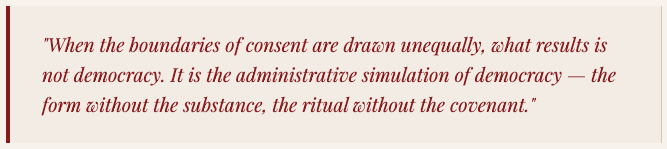
The facts are not disputed. Assam’s 126 assembly constituencies were redrawn in 2023 following the first delimitation exercise in nearly five decades. The stated purpose was equity: to bring constituency sizes in line with population realities. The outcome, examined constituency by constituency, suggests something more complex and considerably less equitable.
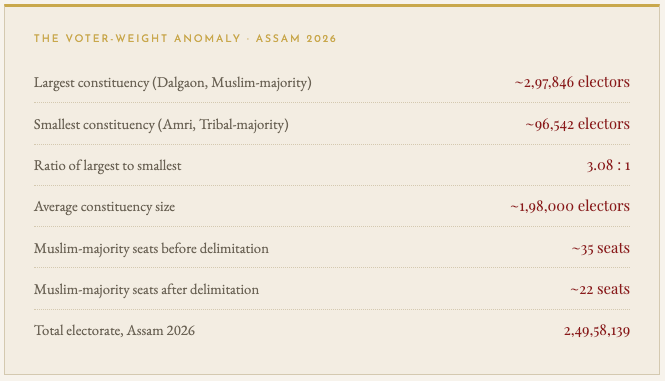
A voter in Amri, therefore, wields three times the political weight of a voter in Dalgaon. Their representative speaks for 96,000 people; the Dalgaon MLA speaks for nearly three times that number. Locke’s each has been quietly replaced by a sliding scale. And the sliding scale, it is worth noting, does not slide randomly. It slides in a very particular direction: downward for constituencies where Muslims form the majority and upward for constituencies where they do not.
II. The Satirist’s Irony: Jinnah Was Right

It is one of history’s more exquisite ironies, the kind that would have delighted Voltaire and appalled Nehru, that the data produced by the 2026 Assam election constitutes, if one squints at it from a certain angle, a retrospective vindication of Mohammed Ali Jinnah.

Jinnah’s central argument, the one that sundered the subcontinent and cost a million lives, was this: that in a democracy defined by simple majority rule, a Muslim minority could never be structurally secure. That the arithmetic of Hindu numerical superiority would, over time and through entirely legal and democratic mechanisms, translate into the permanent political subordination of Muslim citizens. He did not argue that Hindus were evil. He argued that majorities, given sufficient institutional power and sufficient motivation, tend to use that power in the interests of majorities. He called this structural inevitability. He called it the reason for Pakistan.

The liberal consensus of independent India rejected this argument with contempt. It was communal. It was cynical. It was the reasoning of a man who preferred partition to the patience required by pluralism. Ambedkar’s India was to be different—secular, constitutional, and blind to religion in the distribution of political rights.

And yet here we are, seventy-eight years later, in a state where the delimitation exercise has reduced Muslim-majority seats from thirty-five to twenty-two, where the largest electorates cluster in Muslim-majority constituencies and the smallest in Hindu and tribal ones, and where a cabinet minister campaigned in Barpeta by stating openly that the boundaries had been drawn to ensure that “miyas” could not win the seat—and won. Jinnah, one imagines, would not have been surprised. He would merely have noted, with the thin satisfaction of the vindicated prophet, that he had said as much.
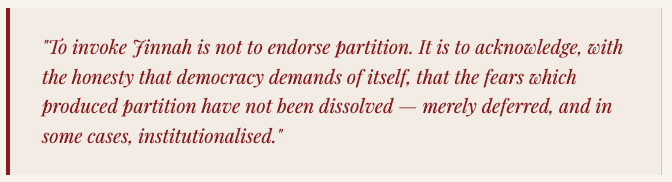
Let us be precise about what is being said here, because precision matters in philosophy as it does in electoral arithmetic. This is not an argument for Pakistan. It is not an argument that Jinnah’s solution was correct. The partition was a catastrophe. The two-nation theory was morally bankrupt. These things remain true.

What is being said is narrower and more uncomfortable: that Jinnah’s diagnosis—not his prescription—has found its evidence in the constituency maps of Assam, 2026. That a democracy that consistently arranges its institutions to dilute the political weight of a minority has ceased, in the Lockean sense, to be a democracy at all.

III. Majoritarianism Is Not Democracy

This distinction between democracy and majoritarianism is one that political philosophers have been drawing with increasing urgency since at least Alexis de Tocqueville, who warned in 1835 of the “tyranny of the majority” as democracy’s most seductive and most dangerous internal corruption. De Tocqueville was writing about the United States of America and its treatment of Black citizens—a context not entirely without resonance for our purposes. His insight was that a system in which fifty-one percent of the population can legally, procedurally, and with full democratic sanction systematically disadvantage the remaining forty-nine percent is not a free society. It is an elective despotism.

John Stuart Mill, writing a generation later, was more precise still. In Considerations on Representative Government (1861), Mill argued that a genuine democracy requires not merely that majorities prevail, but that minorities are represented—that their voices reach the legislature in proportion to their numbers, that their interests are heard, and that the system does not structurally exclude them from political power. A system that fails this test is, in Mill’s formulation, not representative government. It is a majority government—a meaningfully different and considerably lesser thing.

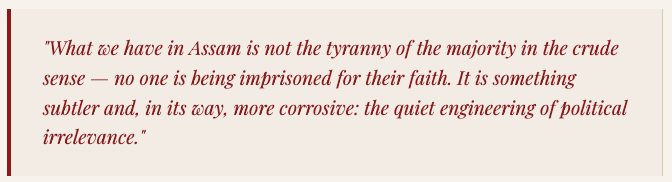
The Assam data meets Mill’s test for majority government with uncomfortable precision. Of the twenty-two seats that Congress won in 2026, all but one are constituencies with Muslim voter pluralities. The party that claims to represent pluralism, secularism, and inclusive nationhood is, in effect, the party of Muslim constituencies—because the delimitation and its consequences have made winning Hindu-majority seats structurally improbable for any non-BJP formation. The political landscape has been sorted, constituency by constituency, into two almost hermetically separate worlds.
IV. The Philosophical Case for Hope

And yet. And yet.

The same philosophical tradition that furnishes our critique also furnishes our reason for hope; and it would be a philosophical dereliction to invoke Locke and Mill only in accusation without also invoking them in aspiration.

Locke’s social contract was not a description of what governments are. It was a prescription for what they ought to be — and, crucially, a theory of what happens when they fail. When a government violates the compact, when it ceases to protect the natural rights of all it governs, the people retain what Locke called the “right of revolution”—not necessarily violent revolution, but the right to withdraw consent, to reconstitute authority, and to demand a more perfect covenant. In constitutional democracies, this right is exercised through courts, through civil society, through journalism, and through the slow accumulation of moral pressure on institutions.

India’s Supreme Court has, in the past, demonstrated a capacity for structural intervention in electoral matters that most constitutional courts would envy. The very delimitation exercise under scrutiny was supervised by the Election Commission: an institution whose independence, though tested in recent years, remains constitutionally guaranteed and civically defended. The data we have examined in this essay is public. It is being written about, argued over, and contested. That contestation is itself a form of democratic life.

Amartya Sen, India’s greatest living contribution to political philosophy, has argued throughout his career that democracy is not merely a mechanism for aggregating preferences—it is a practice of public reasoning. A society that reasons publicly about its own injustices, that names them, measures them, and argues about them, has not abandoned the democratic project. It is, in Sen’s formulation, engaged in its most essential activity.

The voters of Assam—all of them, Hindu and Muslim, Assamese and Bengali, tribal and plains-dweller—deserve a system in which their franchise carries equal weight. That is not a partisan demand. It is not a Congress demand or a BJP demand. It is a Lockean demand, a Millian demand, a human demand, and a fair and equitable demand that flows from the first principles of the political philosophy on which the Indian Constitution was constructed and democracy itself rests.

“India did not choose democracy because it was expedient. It chose democracy because it believed, with Locke, that legitimate authority can only rest on equal consent. That belief has not been repealed. It has merely been tested.”
The ghost of Jinnah should not be allowed the last word in a conversation about India’s democracy. He was right about the danger. He was catastrophically wrong about the remedy. The remedy—the only remedy that does not cost a million lives—is the patient, stubborn insistence on the equal political weight of every citizen, regardless of which side of a redrawn boundary line they happen to live on.

Assam’s rivers have been bridged. Its roads have been built. Its economy has grown. These things are real, and they matter. But a state whose largest constituencies are three times the size of its smallest, whose delimitation reduces minority representation by a third, and whose cabinet ministers campaign openly on the exclusion of communities from political power has a bridge yet to build—one that no chief minister’s inauguration speech will suffice for.

It is the bridge between the India that exists and the India that Locke, Ambedkar, and Patel—and yes, even the India that Jinnah feared would never come—would recognize as worthy of the name democracy.

That bridge is not impossible. It is merely unbuilt. And in a democracy, the unbuilt is always still only a matter of political will and public understanding. The status quo can only be sustained by an unbothered or brainwashed citizenry.

Note: The views expressed invoke the philosophical traditions of Locke, Mill, de Tocqueville, and Sen in the service of democratic accountability and not partisan advantage.

A Rebuke to Plutocratic Paternalism: On the Fundamental Misunderstanding of Democracy

Bill Ackman is misguided….

Bill Ackman’s lengthy Twitter manifesto reveals not concern for democracy, but its precise antithesis—a plutocratic impulse that would make John Locke recoil in horror. His proposal to handpick and finance a mayoral candidate represents everything the Enlightenment philosophers warned against when they conceived of democratic governance based on popular consent rather than elite manipulation.

The Lockean Foundation: Consent of the Governed

John Locke’s Second Treatise of Government established that legitimate political authority derives solely from the consent of the governed. When Ackman declares he will “take care of the fundraising” for his preferred candidate, he fundamentally rejects this cornerstone of democratic theory. He proposes not democracy, but what Locke would recognize as a form of tyranny—rule by wealth rather than popular will.

Bill Ackman (Photo Credit: Wikipedia)

Locke argued that when government ceases to represent the people’s consent, it loses all legitimacy. Ackman’s scheme to bypass the democratic process through massive financial intervention represents precisely this illegitimate exercise of power. His complaint isn’t that democracy failed—it’s that democracy succeeded in ways he finds inconvenient.

The Rousseauian Critique: The General Will vs. Particular Interests

Jean-Jacques Rousseau distinguished between the “general will” of the people and the “particular will” of individuals pursuing their own interests. Ackman’s manifesto is a textbook example of particular will masquerading as public concern. His repeated references to wealthy taxpayers fleeing the city reveal his true constituency—not the citizens of New York, but the financial elite whose interests he represents.

Rousseau warned that when particular interests corrupt the general will, democracy dies. Ackman’s proposal to flood the election with “hundreds of millions of dollars” represents exactly this corruption—the substitution of plutocratic preference for democratic choice.

The Tocquevillian Warning: Tyranny of Wealth

Alexis de Tocqueville, observing American democracy, warned of the potential for a new form of aristocracy based on industrial wealth. Ackman embodies Tocqueville’s nightmare—a financial aristocrat who views democracy as a problem to be solved through superior resources rather than a process to be respected.

Tocqueville wrote: “I am trying to imagine under what novel features despotism may appear in the world.” Ackman provides the answer: despotism draped in the language of civic concern, wielding financial power to override electoral results.

The Moral Double Standard: Democracy When Convenient

Ackman’s selective embrace of democratic outcomes exposes his fundamental hypocrisy. He expressed no concern when American voters elected a convicted felon to the presidency—an outcome that served his political preferences. But when New York Democrats choose a progressive candidate through legitimate democratic process, suddenly democracy requires correction by billionaire intervention.

This represents what philosophers call “motivated reasoning”—the selective application of principles based on desired outcomes rather than consistent democratic values. If Ackman truly believed in democratic legitimacy, he would respect all electoral outcomes, not just those that align with his economic interests.

The Sexist Subtext: “Handsome” Candidates and Democratic Exclusion

Ackman’s repeated emphasis on finding a “handsome, charming” candidate reveals an unconscious but telling bias. The language itself excludes women from consideration—women cannot be “handsome” in his framework. This linguistic slip exposes a broader paternalistic mindset that views politics as the domain of aesthetically pleasing men who can be groomed for public consumption.

John Stuart Mill’s The Subjection of Women anticipated this exact prejudice—the notion that political leadership requires masculine qualities defined by male aesthetics. Ackman’s candidate criteria perpetuate the exclusionary politics that democratic theory explicitly rejects.

The Substantive Policy Failures: Economics vs. Ideology

Ackman’s policy critiques reveal economic illiteracy masquerading as expertise. His claim that rent stabilization reduces housing supply ignores decades of research showing that moderate rent regulations can actually increase housing stability and neighborhood investment. Cities like Vienna have demonstrated that public housing initiatives can successfully provide affordable options without destroying private markets.

His characterization of city-owned markets as “socialist disaster” ignores successful examples worldwide, from Singapore’s public food courts to European municipal utilities. The false binary between capitalism and socialism that underlies his argument would be rejected by any serious economist as ideologically blinkered rather than analytically sound.

The Demographic Reality: Jewish Support for Mamdani

Ackman’s implicit appeal to ethnic solidarity falls flat given that many Jewish New Yorkers supported Mamdani’s candidacy. This support reflects not ethnic betrayal but democratic maturity—the recognition that policy positions matter more than religious or ethnic identity in electoral choices.

Moreover, Mamdani’s interfaith heritage—son of a Muslim father and Hindu mother—represents the pluralistic ideal that American democracy promises. Ackman’s discomfort with this diversity reveals the exclusionary impulses that democratic inclusion seeks to overcome.

The Philosophical Challenge: Run Yourself

If Ackman truly believes his vision represents the people’s will, democratic theory provides a clear remedy: run for office himself. Let him submit his policies to electoral scrutiny rather than attempting to circumvent democracy through financial manipulation.

The fact that he prefers to operate through proxies reveals his fundamental lack of faith in democratic persuasion. He knows his positions cannot win democratic contests, so he seeks to purchase outcomes through superior resources.

Conclusion: Democracy’s Test

Ackman’s manifesto presents democracy with a familiar test—will popular sovereignty succumb to plutocratic manipulation, or will democratic institutions prove resilient enough to resist wealth-based tyranny?

John Locke provided the answer three centuries ago: governments derive their legitimacy from popular consent, not elite approval. When billionaires attempt to override electoral outcomes through financial pressure, they reveal their fundamental antipathy to democratic governance.

New York’s voters have spoken. Their choice deserves respect, not billionaire correction. Democracy means trusting the people to govern themselves—even when their choices displease the wealthy. Anything else isn’t democracy at all, but its sophisticated negation.

The true test of democratic commitment isn’t supporting popular decisions that align with your interests—it’s respecting democratic outcomes that challenge them. By this measure, Ackman fails democracy entirely, revealing himself not as its defender but as its opponent, cloaked in the language of civic concern but motivated by the oldest anti-democratic impulse: the belief that wealth should rule over will.

“The people cannot be all, and always, well informed,” Jefferson wrote, “but they are the only safe depositories of political power.” Ackman’s manifesto proves Jefferson’s wisdom—when elites lose faith in popular judgment, democracy itself becomes their target.

The Last Photograph

In a dim-lit chamber of a museum that no longer exists, in a city whose name has been rewritten, hangs a curious photograph. When they still worked there, the docents would hurry past it, averting their eyes. Some claimed their shoes would inexplicably fill with sand whenever they lingered too long before it, while others reported hearing distant echoes of breaking marble.

The photograph shows two men seated in oversized chairs; their faces frozen in smiles from muscles trained in deception rather than joy. The chairs, grotesquely ornate, seem to consume their occupants like wooden predators digesting prey. Every year, the chairs in the photograph appear to grow larger, while the men shrink imperceptibly, though no curator has ever dared to measure.

One ruled from a palace in Damascus, where ancient stones whispered warnings he refused to hear, where Roman ghosts walked corridors laughing at his temporary reign. The other commanded from Dhaka, where Bengal tigers once roamed and where his father’s legacy cast shadows longer than minarets, shadows that eventually grew teeth and turned to bite the hand that claimed them.

Both men had inherited their kingdoms like badly fitted suits, wearing power as though it were a birthright rather than a loan from time. They collected titles like children collect seashells, not realizing that each new honorific added weight to the anchors around their necks. Their bureaucrats invented ever more elaborate forms of address – Supreme Leader, Father of the Nation, Guardian of the Sacred Places, Protector of the People’s Dreams – until the very air in their presence grew thick with syllables of self-importance.

In the photograph, they are signing some treaty or accord – the exact nature of which is now as irrelevant as last week’s weather forecast. Their pens hover over papers that would soon turn to dust, their signatures ensuring promises that would outlive neither of them. Behind them stand rows of ministers and advisors, each face bearing the carefully blank expression of men who have mastered the art of agreeing with their own erasure.

What makes the photograph peculiar is not what it shows but what happened to it. As their regimes crumbled – one in the heat of August, the other in December’s chill – the photograph began to fade, not from the edges inward as old photographs do, but from the men themselves. First, their eyes grew hollow, then their features blurred, until all that remained were two empty chairs and hovering pens, signing nothingness into oblivion. The ministers behind them faded too, row by row like a theater being emptied after the final act of a very long, very tedious play.

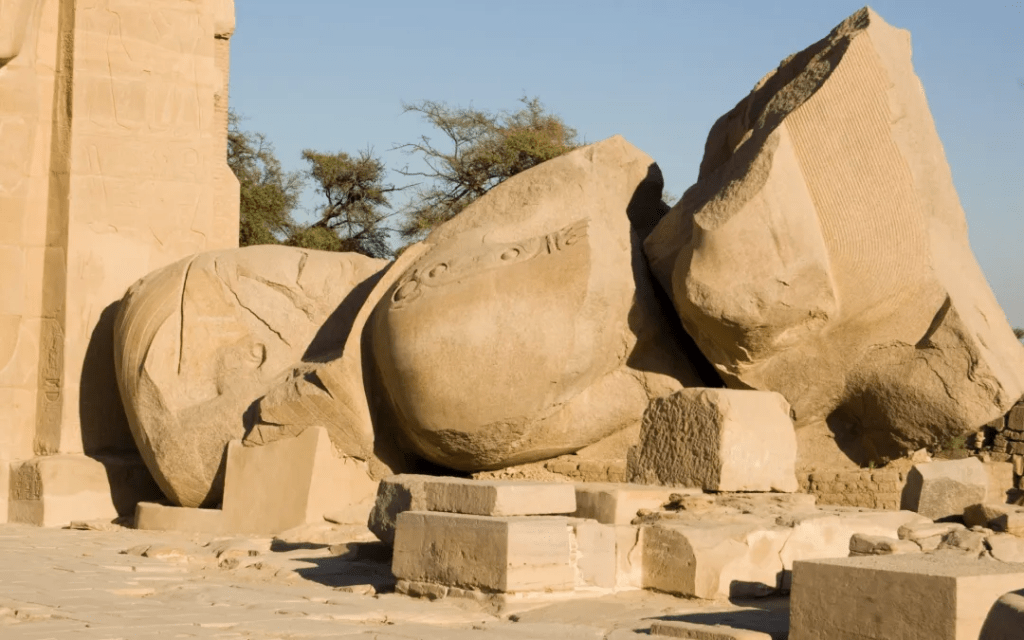
The museum’s final curator, before fleeing with the rest, swore the photograph would sometimes whisper at night, in a voice like wind through ruins: “Look on my Works, ye Mighty, and despair!” Some nights, the whispers would grow into conversations, as though the photograph was arguing with itself about the nature of permanence.

In the weeks before the museum’s abandonment, visitors reported strange phenomena. The photograph seemed to weep on Tuesdays, though the tears turned to dust before reaching the floor. On Fridays, it would emit a sound like distant laughter, though whether of joy or madness none could say. Children claimed they could see butterflies emerging from the fading ink of the unsigned treaties.

But the story doesn’t end there, for where their images faded, something else began to appear. First came the ghostly outlines of demolished statues, then the shadows of toppled monuments. But these too faded, making way for something far more substantial: Children playing in streets once blocked by tanks. Women spoke in voices that had been silenced for generations. Men embracing neighbors they’d been taught to fear. The photograph, like history itself, was being rewritten.

The transformation continued, defying all known laws of photography and physics. The ornate chairs crumbled into garden soil. The unsigned treaties bloomed into flowers. The blank walls behind became windows opening onto possibilities that had always existed but had never been permitted to be seen.

Now, in place of two tyrants’ frozen smiles, there blooms a garden of faces – countless, ordinary, extraordinary faces of people who had always been there, waiting in the shadows of statues that thought themselves eternal. Their images grow clearer with each passing day, as though the photograph is learning to tell a different kind of truth. Each face bears a story that was always worth telling but had been deemed too simple for official histories: a grandmother’s recipe for courage, a student’s theorem proving the mathematics of hope, a farmer’s almanac predicting seasons of change.

And if you listen carefully, in the quiet hours when museums dream, you might hear a new whisper, carried on the same wind that once spoke of despair: “Look on our works, ye mighty, and hope.” The whisper grows stronger with each passing day, as though the very air is remembering how to carry voices that speak without permission or fear.

For in the end, it is not in marble halls or gilded thrones, or some gladiator stadium, that power truly resides, but in the persistent, defiant bloom of human dignity – the one force that no dynasty, no matter how fearsome, has ever managed to outlast. The photograph hangs there still, in a museum that no longer exists, telling its endless story to anyone who dares to look long enough to see themselves reflected in its changing surface.

And sometimes, on very quiet mornings, visitors swear they can hear the sound of distant wings, as though all the butterflies of history are taking flight at once.

The People’s Family: A Tale of Pappu Democracy

At a packed press conference in New Delhi, the entire Popolare family beamed with pride as they occupied their usual four seats in Parliament. “Democracy is in our DNA,” declared patriarch Pappu Popolare, adjusting his ₹20 lakh Nehru jacket. “It’s purely coincidental that my sister Pripanka represents South constituency, while I represent North.”

“And it’s totally democratic that I represent West,” chimed in their mother, Sonear, checking her Swiss watch. “The people chose me over other candidates who just happened to withdraw their nominations the day before elections.” Their adopted brother Giovanna, MP from somewhere East of Delhi, nodded sagely while typing on his fourth iPhone of the month. “Merit alone got us here. The fact that our family controls the party is completely irrelevant.”

“We’re proud that our family dinner table is now a mini-Parliament,” Pripanka announced, her diamond-studded democracy pendant glinting. “Though of course, we only discuss the weather and Roberta, never politics.” The family then unveiled their new foundation: “People’s Voice Against Dynasty Politics”, headquartered in their 50-acre ancestral democratic farmhouse. When asked about the statistical improbability of four family members becoming MPs, Pappu smiled benevolently: “Numbers are so anti-national. They never tell the truth. They simply don’t add up. All of India are my brothers and sisters. Our success is purely due to the mysterious ways in which democracy works.”

Statistics and Probability be damned!!

Now, talking about probabilities, let’s take a look:

Basic Numbers:

  • Total MP seats: 543 (Lok Sabha)
  • Indian population: Approximately 1.4 billion
  • Eligible voting population: ~950 million

Base mathematical probability of being elected an MP:

  • Raw probability = Number of seats / Eligible population
  • 543 / 950,000,000 = 0.00000057 or about 0.000057%

Initial Parameters:

  • Base probability of becoming an MP = 0.000057% (0.00000057)

Family Dynamics Enhancement Factors:

  • Political spouse advantage: 15x
  • Political children advantage: 20x

Sequential Probability Calculation:

  1. First Family Member:
    • Raw probability: 0.00000057 (0.000057%)
  2. Second Family Member (Spouse)
    • Enhanced probability: 0.00000057 × 15 = 0.00000855 (0.000855%)
  3. First Child
    • Enhanced probability: 0.00000057 × 20 = 0.0000114 (0.00114%)
  4. Second Child
    • Enhanced probability: 0.00000057 × 20 = 0.0000114 (0.00114%)

Compound Probability Calculation:

Total Probability = p(First Member) × p(Second Member) × p(First Child) × p(Second Child)

= 0.00000057 × 0.00000855 × 0.0000114 × 0.0000114

= 6.35 × 10^(-16) = 0.0000000000000635% = approximately 1 in 1.6 quadrillion.

To put this astronomical number in perspective:

  1. The universe is estimated to be about 13.8 billion years old, or about 435 quadrillion seconds. So, this probability is like picking a specific second from about 3.7 universes’ worth of time!
  2. Comparing it to the current world population (8 billion):
    • If every person on Earth tried this scenario
    • They would need to try about 200,000 times each
    • To expect to see it happen just once!
  3. To compare with something more tangible:
    • If you had 1.6 quadrillion grains of rice
    • And spread them across India’s total surface area
    • The layer would be several meters thick!