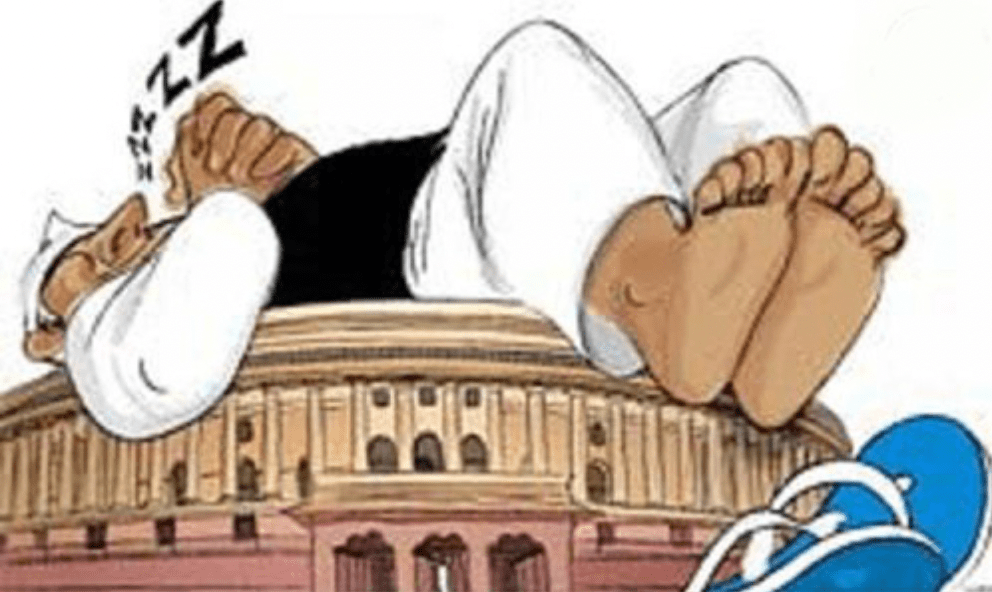
The Geometry of Injustice

On majoritarianism, the ghost of Jinnah, and the philosophical foundations of a democracy that counts some votes more than others

John Locke, writing in his Second Treatise of Government in 1689, proposed a deceptively simple compact: that legitimate political authority derives not from the divine right of kings nor from the brute fact of military conquest, but from the consent of the governed, each individual surrendering a portion of natural liberty to a commonwealth in exchange for the protection of life, liberty, and property. The operative word, so easily passed over, is each. Not some. Not the majority. Each. The social contract, for Locke, was universal in its application, or it was nothing at all. It was a covenant, not a calculation.

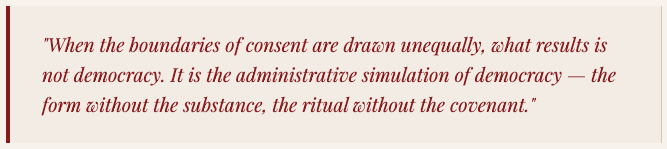
Three hundred and thirty-seven years after Locke set down his quill, the results of the Assam Assembly election 2026 invite us to revisit his compact, not to celebrate it, but to measure how far the world’s largest democracy has drifted from its philosophical foundations. The numbers, examined without sentiment, produce a conclusion that is both arithmetically precise and morally uncomfortable: in Assam, not all votes are equal. Some votes, it turns out, are considerably more equal than others.

I. The Mathematics of Unequal Citizenship

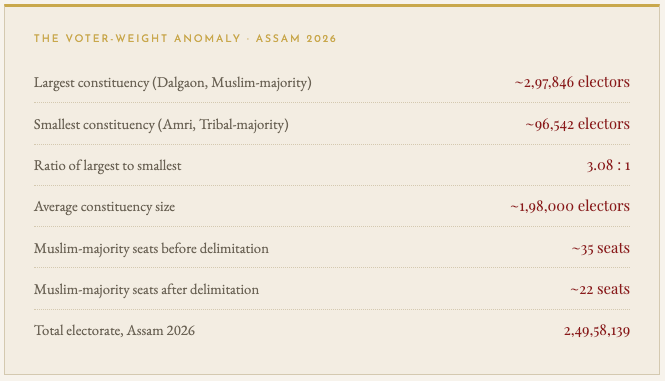
The facts are not disputed. Assam’s 126 assembly constituencies were redrawn in 2023 following the first delimitation exercise in nearly five decades. The stated purpose was equity: to bring constituency sizes in line with population realities. The outcome, examined constituency by constituency, suggests something more complex and considerably less equitable.

A voter in Amri, therefore, wields three times the political weight of a voter in Dalgaon. Their representative speaks for 96,000 people; the Dalgaon MLA speaks for nearly three times that number. Locke’s each has been quietly replaced by a sliding scale. And the sliding scale, it is worth noting, does not slide randomly. It slides in a very particular direction: downward for constituencies where Muslims form the majority and upward for constituencies where they do not.

II. The Satirist’s Irony: Jinnah Was Right

It is one of history’s more exquisite ironies, the kind that would have delighted Voltaire and appalled Nehru, that the data produced by the 2026 Assam election constitutes, if one squints at it from a certain angle, a retrospective vindication of Mohammed Ali Jinnah.

Jinnah’s central argument, the one that sundered the subcontinent and cost a million lives, was this: that in a democracy defined by simple majority rule, a Muslim minority could never be structurally secure. That the arithmetic of Hindu numerical superiority would, over time and through entirely legal and democratic mechanisms, translate into the permanent political subordination of Muslim citizens. He did not argue that Hindus were evil. He argued that majorities, given sufficient institutional power and sufficient motivation, tend to use that power in the interests of majorities. He called this structural inevitability. He called it the reason for Pakistan.

The liberal consensus of independent India rejected this argument with contempt. It was communal. It was cynical. It was the reasoning of a man who preferred partition to the patience required by pluralism. Ambedkar’s India was to be different—secular, constitutional, and blind to religion in the distribution of political rights.

And yet here we are, seventy-eight years later, in a state where the delimitation exercise has reduced Muslim-majority seats from thirty-five to twenty-two, where the largest electorates cluster in Muslim-majority constituencies and the smallest in Hindu and tribal ones, and where a cabinet minister campaigned in Barpeta by stating openly that the boundaries had been drawn to ensure that “miyas” could not win the seat—and won. Jinnah, one imagines, would not have been surprised. He would merely have noted, with the thin satisfaction of the vindicated prophet, that he had said as much.

Let us be precise about what is being said here, because precision matters in philosophy as it does in electoral arithmetic. This is not an argument for Pakistan. It is not an argument that Jinnah’s solution was correct. The partition was a catastrophe. The two-nation theory was morally bankrupt. These things remain true.

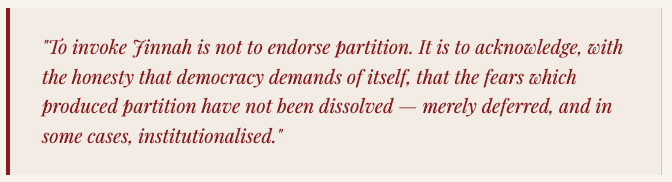
What is being said is narrower and more uncomfortable: that Jinnah’s diagnosis—not his prescription—has found its evidence in the constituency maps of Assam, 2026. That a democracy that consistently arranges its institutions to dilute the political weight of a minority has ceased, in the Lockean sense, to be a democracy at all.

III. Majoritarianism Is Not Democracy

This distinction between democracy and majoritarianism is one that political philosophers have been drawing with increasing urgency since at least Alexis de Tocqueville, who warned in 1835 of the “tyranny of the majority” as democracy’s most seductive and most dangerous internal corruption. De Tocqueville was writing about the United States of America and its treatment of Black citizens—a context not entirely without resonance for our purposes. His insight was that a system in which fifty-one percent of the population can legally, procedurally, and with full democratic sanction systematically disadvantage the remaining forty-nine percent is not a free society. It is an elective despotism.

John Stuart Mill, writing a generation later, was more precise still. In Considerations on Representative Government (1861), Mill argued that a genuine democracy requires not merely that majorities prevail, but that minorities are represented—that their voices reach the legislature in proportion to their numbers, that their interests are heard, and that the system does not structurally exclude them from political power. A system that fails this test is, in Mill’s formulation, not representative government. It is a majority government—a meaningfully different and considerably lesser thing.

The Assam data meets Mill’s test for majority government with uncomfortable precision. Of the twenty-two seats that Congress won in 2026, all but one are constituencies with Muslim voter pluralities. The party that claims to represent pluralism, secularism, and inclusive nationhood is, in effect, the party of Muslim constituencies—because the delimitation and its consequences have made winning Hindu-majority seats structurally improbable for any non-BJP formation. The political landscape has been sorted, constituency by constituency, into two almost hermetically separate worlds.

IV. The Philosophical Case for Hope

And yet. And yet.

The same philosophical tradition that furnishes our critique also furnishes our reason for hope; and it would be a philosophical dereliction to invoke Locke and Mill only in accusation without also invoking them in aspiration.

Locke’s social contract was not a description of what governments are. It was a prescription for what they ought to be — and, crucially, a theory of what happens when they fail. When a government violates the compact, when it ceases to protect the natural rights of all it governs, the people retain what Locke called the “right of revolution”—not necessarily violent revolution, but the right to withdraw consent, to reconstitute authority, and to demand a more perfect covenant. In constitutional democracies, this right is exercised through courts, through civil society, through journalism, and through the slow accumulation of moral pressure on institutions.

India’s Supreme Court has, in the past, demonstrated a capacity for structural intervention in electoral matters that most constitutional courts would envy. The very delimitation exercise under scrutiny was supervised by the Election Commission: an institution whose independence, though tested in recent years, remains constitutionally guaranteed and civically defended. The data we have examined in this essay is public. It is being written about, argued over, and contested. That contestation is itself a form of democratic life.

Amartya Sen, India’s greatest living contribution to political philosophy, has argued throughout his career that democracy is not merely a mechanism for aggregating preferences—it is a practice of public reasoning. A society that reasons publicly about its own injustices, that names them, measures them, and argues about them, has not abandoned the democratic project. It is, in Sen’s formulation, engaged in its most essential activity.

The voters of Assam—all of them, Hindu and Muslim, Assamese and Bengali, tribal and plains-dweller—deserve a system in which their franchise carries equal weight. That is not a partisan demand. It is not a Congress demand or a BJP demand. It is a Lockean demand, a Millian demand, a human demand, and a fair and equitable demand that flows from the first principles of the political philosophy on which the Indian Constitution was constructed and democracy itself rests.

“India did not choose democracy because it was expedient. It chose democracy because it believed, with Locke, that legitimate authority can only rest on equal consent. That belief has not been repealed. It has merely been tested.”

The ghost of Jinnah should not be allowed the last word in a conversation about India’s democracy. He was right about the danger. He was catastrophically wrong about the remedy. The remedy—the only remedy that does not cost a million lives—is the patient, stubborn insistence on the equal political weight of every citizen, regardless of which side of a redrawn boundary line they happen to live on.

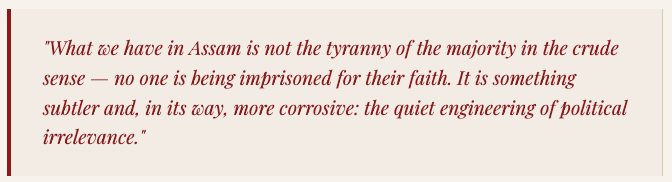
Assam’s rivers have been bridged. Its roads have been built. Its economy has grown. These things are real, and they matter. But a state whose largest constituencies are three times the size of its smallest, whose delimitation reduces minority representation by a third, and whose cabinet ministers campaign openly on the exclusion of communities from political power has a bridge yet to build—one that no chief minister’s inauguration speech will suffice for.

It is the bridge between the India that exists and the India that Locke, Ambedkar, and Patel—and yes, even the India that Jinnah feared would never come—would recognize as worthy of the name democracy.

That bridge is not impossible. It is merely unbuilt. And in a democracy, the unbuilt is always still only a matter of political will and public understanding. The status quo can only be sustained by an unbothered or brainwashed citizenry.

Note: The views expressed invoke the philosophical traditions of Locke, Mill, de Tocqueville, and Sen in the service of democratic accountability and not partisan advantage.

The Mirage of Indian Secularism

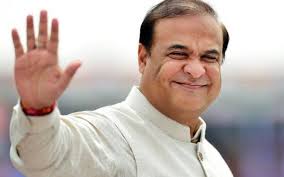
Our beloved CM, Dr. Himanta Biswa Sarma is 100% right!

When Niccolò Machiavelli warned that “people are more often moved by the appearance of things than by their reality,” he could have been describing modern India’s constitutional self-portrait. The Preamble that now proclaims the Republic “secular” carries a reassuring gloss, yet the lived history of the state betrays a different hue. Words alone cannot transmute a civilization’s deepest instincts, and the word “secular”—stitched hurriedly into the Constitution during the Emergency of 1976—has never truly described the republic it adorns.

Defining Secularism

In its classical sense, secularism demands two rigors: first, that the state refuse to privilege any faith; second, that religion remain a private affair, quarantined from public policy. In France this ideal is laïcité; in the United States it is the wall of separation. By either yardstick, a state that collects temple revenue, subsidizes pilgrimages, and legislates different family laws for different faiths cannot claim the title. India, therefore, has been plural—teeming with faiths—but never secular in the truest sense.

Secularism in Text, Partiality in Practice

The 42nd Amendment—passed in the dark night of the Emergency—inserted “secular” and “socialist” into a Preamble that the framers had deliberately left unburdened by ideological labels. But the amendment did not dismantle a single structure of religious preference. Muslim personal law still stands apart from the Hindu Code; churches and madrassas may manage their institutions free of state interference, while major Hindu temples remain under bureaucratic control. Even the long-running Haj subsidy, sustained for decades at taxpayer expense and struck down only in 2018, showed a state willing to underwrite one community’s devotional journey while taxing all others.

Judges themselves have lamented the inconsistency. In Sarla Mudgal v. Union of India (1995), the Supreme Court decried the absence of a Uniform Civil Code, observing that a patchwork of faith-based laws conflicts with the equality the Constitution promises. Such anomalies are not aberrations; they are evidence that the Indian state has never embraced secular neutrality.

Pluralism, the Indian Genius

What India does embody—radiantly—is pluralism: the ancient ideal of Sarva-dharma-sambhāva, equal regard for every path to the divine. Here, many faiths thrive because a broad Hindu civilizational ethos has traditionally offered space, not because the state stands aloof. To conflate this civilizational hospitality with secularism is to mistake a banyan tree for the open sky that shelters it.

Toward an Honest Settlement: Declaring a Hindu Rashtra

Honesty, like justice, begins with naming things correctly. If India’s public institutions, cultural symbols, and legal compromises already presume a Hindu civilizational framework, then let the Constitution say so plainly. A Hindu Rashtra need not—indeed must not—diminish the equal civil and political rights of any citizen; rather, it would acknowledge the civilization from which those pluralist instincts spring. By removing the ill-fitting label of “secular,” Parliament would align text with truth, dissolve the cognitive dissonance that fuels communal grievance, and invite minorities to engage the majority culture without the pretense of a neutrality that does not exist.

Call to Action

The time has come for constitutional candour. Parliament should move a comprehensive amendment that (i) excises the Emergency-era appendage “secular,” (ii) enacts a Uniform Civil Code to guarantee identical civic rights and duties for all Indians, and (iii) affirms India as a Hindu Rashtra founded on the principle of Sarva-dharma-sambhāva. Such an act would replace the comfort of an illusion with the sturdier peace of truth, allowing every community—majority or minority—to negotiate its future honestly within the republic’s real cultural home.

A Rebuke to Plutocratic Paternalism: On the Fundamental Misunderstanding of Democracy

Bill Ackman is misguided….

Bill Ackman’s lengthy Twitter manifesto reveals not concern for democracy, but its precise antithesis—a plutocratic impulse that would make John Locke recoil in horror. His proposal to handpick and finance a mayoral candidate represents everything the Enlightenment philosophers warned against when they conceived of democratic governance based on popular consent rather than elite manipulation.

The Lockean Foundation: Consent of the Governed

John Locke’s Second Treatise of Government established that legitimate political authority derives solely from the consent of the governed. When Ackman declares he will “take care of the fundraising” for his preferred candidate, he fundamentally rejects this cornerstone of democratic theory. He proposes not democracy, but what Locke would recognize as a form of tyranny—rule by wealth rather than popular will.

Bill Ackman (Photo Credit: Wikipedia)

Locke argued that when government ceases to represent the people’s consent, it loses all legitimacy. Ackman’s scheme to bypass the democratic process through massive financial intervention represents precisely this illegitimate exercise of power. His complaint isn’t that democracy failed—it’s that democracy succeeded in ways he finds inconvenient.

The Rousseauian Critique: The General Will vs. Particular Interests

Jean-Jacques Rousseau distinguished between the “general will” of the people and the “particular will” of individuals pursuing their own interests. Ackman’s manifesto is a textbook example of particular will masquerading as public concern. His repeated references to wealthy taxpayers fleeing the city reveal his true constituency—not the citizens of New York, but the financial elite whose interests he represents.

Rousseau warned that when particular interests corrupt the general will, democracy dies. Ackman’s proposal to flood the election with “hundreds of millions of dollars” represents exactly this corruption—the substitution of plutocratic preference for democratic choice.

The Tocquevillian Warning: Tyranny of Wealth

Alexis de Tocqueville, observing American democracy, warned of the potential for a new form of aristocracy based on industrial wealth. Ackman embodies Tocqueville’s nightmare—a financial aristocrat who views democracy as a problem to be solved through superior resources rather than a process to be respected.

Tocqueville wrote: “I am trying to imagine under what novel features despotism may appear in the world.” Ackman provides the answer: despotism draped in the language of civic concern, wielding financial power to override electoral results.

The Moral Double Standard: Democracy When Convenient

Ackman’s selective embrace of democratic outcomes exposes his fundamental hypocrisy. He expressed no concern when American voters elected a convicted felon to the presidency—an outcome that served his political preferences. But when New York Democrats choose a progressive candidate through legitimate democratic process, suddenly democracy requires correction by billionaire intervention.

This represents what philosophers call “motivated reasoning”—the selective application of principles based on desired outcomes rather than consistent democratic values. If Ackman truly believed in democratic legitimacy, he would respect all electoral outcomes, not just those that align with his economic interests.

The Sexist Subtext: “Handsome” Candidates and Democratic Exclusion

Ackman’s repeated emphasis on finding a “handsome, charming” candidate reveals an unconscious but telling bias. The language itself excludes women from consideration—women cannot be “handsome” in his framework. This linguistic slip exposes a broader paternalistic mindset that views politics as the domain of aesthetically pleasing men who can be groomed for public consumption.

John Stuart Mill’s The Subjection of Women anticipated this exact prejudice—the notion that political leadership requires masculine qualities defined by male aesthetics. Ackman’s candidate criteria perpetuate the exclusionary politics that democratic theory explicitly rejects.

The Substantive Policy Failures: Economics vs. Ideology

Ackman’s policy critiques reveal economic illiteracy masquerading as expertise. His claim that rent stabilization reduces housing supply ignores decades of research showing that moderate rent regulations can actually increase housing stability and neighborhood investment. Cities like Vienna have demonstrated that public housing initiatives can successfully provide affordable options without destroying private markets.

His characterization of city-owned markets as “socialist disaster” ignores successful examples worldwide, from Singapore’s public food courts to European municipal utilities. The false binary between capitalism and socialism that underlies his argument would be rejected by any serious economist as ideologically blinkered rather than analytically sound.

The Demographic Reality: Jewish Support for Mamdani

Ackman’s implicit appeal to ethnic solidarity falls flat given that many Jewish New Yorkers supported Mamdani’s candidacy. This support reflects not ethnic betrayal but democratic maturity—the recognition that policy positions matter more than religious or ethnic identity in electoral choices.

Moreover, Mamdani’s interfaith heritage—son of a Muslim father and Hindu mother—represents the pluralistic ideal that American democracy promises. Ackman’s discomfort with this diversity reveals the exclusionary impulses that democratic inclusion seeks to overcome.

The Philosophical Challenge: Run Yourself

If Ackman truly believes his vision represents the people’s will, democratic theory provides a clear remedy: run for office himself. Let him submit his policies to electoral scrutiny rather than attempting to circumvent democracy through financial manipulation.

The fact that he prefers to operate through proxies reveals his fundamental lack of faith in democratic persuasion. He knows his positions cannot win democratic contests, so he seeks to purchase outcomes through superior resources.

Conclusion: Democracy’s Test

Ackman’s manifesto presents democracy with a familiar test—will popular sovereignty succumb to plutocratic manipulation, or will democratic institutions prove resilient enough to resist wealth-based tyranny?

John Locke provided the answer three centuries ago: governments derive their legitimacy from popular consent, not elite approval. When billionaires attempt to override electoral outcomes through financial pressure, they reveal their fundamental antipathy to democratic governance.

New York’s voters have spoken. Their choice deserves respect, not billionaire correction. Democracy means trusting the people to govern themselves—even when their choices displease the wealthy. Anything else isn’t democracy at all, but its sophisticated negation.

The true test of democratic commitment isn’t supporting popular decisions that align with your interests—it’s respecting democratic outcomes that challenge them. By this measure, Ackman fails democracy entirely, revealing himself not as its defender but as its opponent, cloaked in the language of civic concern but motivated by the oldest anti-democratic impulse: the belief that wealth should rule over will.

“The people cannot be all, and always, well informed,” Jefferson wrote, “but they are the only safe depositories of political power.” Ackman’s manifesto proves Jefferson’s wisdom—when elites lose faith in popular judgment, democracy itself becomes their target.

The Bureau of Linguistic Standardization

One morning, as K awoke from troubled dreams involving conjugated verbs, he transformed into a walking Rosetta Stone. His skin was covered in scripts—Devanagari swirled around his left arm, Tamil danced across his chest, and Mandarin characters floated above his head like an ethereal crown. The transformation wasn’t excruciating, just bureaucratically inconvenient.

His first instinct was to call in sick to the Bureau of Linguistic Standardization, where he worked as a junior clerk in the Department of Acceptable Utterances, but he recalled that today was his annual language compliance check. Missing it would mean automatic demotion to the Department of Grunts and Gestures, located in the windowless sub-basement where failed linguistics professors spent their days cataloging prehistoric interjections.

K arrived at the massive brutalist building that housed the Bureau, its concrete façade carved with every known alphabet, including three that had been invented by particularly ambitious interns. The security guard, who spoke exclusively in palindromes, gave him a suspicious look.

“Madam, in Eden, I’m Adam,” the guard said, checking K’s ID.

“Never odd or even,” K replied with the traditional palindromic response, though the words emerged from his mouth in seventeen different languages simultaneously.

The guard’s eyes widened. “A man, a plan, a canal: Panama?”

K just shrugged, causing the Sanskrit on his shoulders to rearrange itself into a detailed grammatical analysis of his gesture.

The elevator was out of order – something about a disagreement between the “UP” and “DOWN” buttons regarding their etymological ancestry – so K took the stairs to the 42nd floor. Each step was labeled with a different way to say “step” in various languages, and K could have sworn some of them changed as he passed.

The waiting room of the Office of Language Compliance was packed with the usual crowd. A woman who could only speak in obsolete programming languages was arguing with a receptionist who responded exclusively in bird calls. In the corner, a man who had accidentally learned Esperanto was trying to unlearn it by reading government pamphlets backward.

“Next!” called out an official in perfect BBC English, though she appeared to be speaking from several mouths simultaneously, each one pronouncing a different dialect.

K entered the office of Senior Language Inspector Babel, whose desk was made entirely of stacked dictionaries. The inspector herself was a small woman wearing glasses that seemed to be made of solidified alphabet soup.

“Your language license has expired,” Inspector Babel declared, her words manifesting as floating text in multiple scripts. “You must choose one Official Language™ for all future communications. And what,” she added, adjusting her glasses to peer at K’s script-covered form, “seems to have happened to you?”

“I woke up like this,” K explained, his response emerging as a linguistic symphony. “I believe it might be a case of acute polyglottism with complications of semiotic hyperexpression.”

“Hmm,” the inspector consulted a manual titled “Bureaucratic Responses to Spontaneous Linguistic Phenomena, Volume XLVII.” “Have you been reading unauthorized translations? Engaging in recreational etymology? Conjugating irregularly?”

“No,” K protested, though he did feel guilty about that copy of “Finnegans Wake” he’d been keeping under his mattress.

Inspector Babel sighed, causing several ancient scrolls on her desk to unfurl. “Fill out these forms in the Mother of All Languages,” she said, pushing a stack of papers across the desk that kept transforming – Sanskrit became Aramaic became Proto-Indo-European became binary code became birdsong.

In the next cubicle, K could hear someone wailing, “But I dream in Esperanto and sleep-talk in Klingon! How can I choose just one?”

The ceiling began to rain linguistic textbooks. A group of etymologists in white lab coats rushed past, chasing an escaped etymology of the word “bureaucracy” that was leaving trails of Latin roots in its wake. K noticed that one of the younger etymologists had “ETYMOLOGY IS DESTINY” tattooed on his arm in Proto-Sinaitic.

K stared at the forms, which now seemed to be written in a script that predated writing itself. “Perhaps,” he suggested, as ancient hieroglyphs bloomed like flowers from his fingertips, “we could just listen to each other, regardless of the language?”

Inspector Babel’s glasses cracked slightly. “That kind of thinking is dangerous,” she whispered in Sumerian. “Next you’ll be suggesting that meaning can exist without proper bureaucratic approval.”

Just then, the weight of all the dictionaries proved too much for the inspector’s desk. As it collapsed, pages flew through the air in a linguistic blizzard. K could see that every word in every language was actually saying the same thing: “Hello, friend.”

The sight caused a chain reaction throughout the Bureau. The walls, which had been holding back a sea of suppressed expressions, burst. Thousands of words in hundreds of languages flooded the office. Emergency alarm systems began blaring in all known forms of communication, including interpretive dance.

In the chaos, K noticed something extraordinary. His skin scripts were starting to make sense – not as individual languages, but as a single, unified expression of human experience. The Devanagari on his arm was completing the thoughts begun by the Tamil on his chest, while the Mandarin characters above his head provided commentary on both.

Inspector Babel was standing on her chair, desperately trying to maintain order by shouting regulations in Akkadian. But it was too late. The flood of languages had breached the building’s foundations, and pure meaning was pouring in through every crack.

As the Bureau crumbled around them, K grabbed the inspector’s hand. “Quick,” he said in every language at once, “we have to get out before the whole system collapses!”

They ran down the emergency stairs, past floors where rigid grammar rules were dissolving into poetry, past offices where language families that had been separated for millennia were joyfully reuniting, past cubicles where employees were discovering they could understand each other perfectly without a single standardized form.

They burst out of the building just as the last of the bureaucratic structure dissolved into a shower of letters from every alphabet ever invented. The other employees were already there, standing in a daze as they watched their workplace transform into a tower of pure communication.

“What have you done?” Inspector Babel asked, but her voice had lost its bureaucratic certainty. The alphabet soup in her glasses had rearranged itself to spell out “FREEDOM.”

“I didn’t do anything,” K replied. “Languages have always been like this – living, breathing things that grow and change and interact. We just tried to put them in boxes.”

As if to prove his point, the scripts on his skin began to fade, leaving behind not blank flesh but a palimpsest of understanding – the ability to see the connections between all forms of human expression.

In the days that followed, the Bureau of Linguistic Standardization was replaced by the Garden of Linguistic Diversity, where languages were free to grow wild and cross-pollinate. K became its first curator, though he never did figure out how to file his taxes in Proto-World.

Inspector Babel joined him as head etymologist, her alphabet soup glasses now showing a different quote about language every day. Her favorite was, “In the beginning was the Word, and the Word was ‘Hello.'”

And so it was that the great liberation of language came not through revolution or reform, but through the simple recognition that all human speech, from the most ancient grunt to the most recent emoji, was just another way of reaching out to say, “I am here. I see you. Let’s talk.”

The end of standardization marked the beginning of understanding.

Though occasionally, late at night, if you listen carefully near the ruins of the old Bureau, you can still hear the ghost of a particularly stubborn participle, endlessly conjugating itself in the dark.

The Great Kiss Katastrophe of Kotakola

In the mystical city of Kotakola, where trams ran on tea leaves and morality was measured in millimeters, the Great Kiss Katastrophe of 2024 began with two lips mysteriously meeting at the Kalighata Metro Station. The city’s moral fabric, carefully woven from centuries of raised eyebrows and tutting tongues, unraveled faster than a grandmother’s sweater in a ceiling fan.

The Defenders of Decency, led by the illustrious Mammoth Shankar, immediately convened an emergency meeting of the Committee for the Prevention of Public Displays of Almost Anything (CPPDA). “In France, they kiss on streets,” she declared, clutching her pearls so tightly they threatened to turn into diamonds. “But this is Kotakola, where we prefer our love like our tea – watered down and served with appropriate social distance!”

The CPPDA headquarters, located in a building shaped much like a disapproving aunt, buzzed with activity. Subcommittees were formed with impressive speed: the Bureau of Acceptable Hand-Holding Distances, the Department of Proper Public Posture, and the elite task force known as GASP (Guardians Against Spontaneous Passion).

Meanwhile, the Anti-Romeo Squad, fresh from issuing their 1.26 billionth warning slip (printed on recycled moral fiber), patrolled the parks with special “PDA-detecting” binoculars that mysteriously stopped working whenever actual harassment occurred. Their motto: “We see all evil, except when we don’t want to.” They had recently upgraded their equipment to include “Morality Radars” – devices that beeped whenever two people stood closer than the officially mandated distance of three coconuts and a banana leaf.

Young Kotakolans, however, had different ideas. Ali from Tangra pointed out that the city’s moral guardians seemed more disturbed by two people kissing than by the local tradition of competitive public spitting, which had recently been declared an Olympic sport. “We have people treating the streets like their personal spittoon,” he observed, “but heaven forbid someone shows affection!”

Nabaneeta from Tollygunge started a movement called “Kisses Against Chaos,” arguing that perhaps if the moral police spent less time monitoring metro stations for affection, they might notice the actual crimes happening under their professionally averted gaze. Her group began organizing “Standing Still While Looking Happy” protests, which thoroughly confused the authorities who couldn’t decide if looking content in public was against the rules or not.

The situation took an interesting turn when Srotaswini, a local advertising professional, launched a campaign titled “Save Our Statues.” The city’s ancient statues, tired of being the only ones allowed to display bare skin in public, reportedly began covering themselves with saris and sending strongly worded letters to the municipal corporation about “these modern couples making us uncomfortable.” The 500-year-old sculptures at the museum were particularly vocal, though some suspected this had more to do with their recent renovation with WiFi capabilities than actual moral outrage.

The crisis deepened when the CPPDA proposed the “Public Propriety Protection Act,” which would require all couples in public to maintain a distance measurable by at least one medium-sized autorickshaw. Street vendors quickly capitalized on this by selling “Officially Approved Romance Rulers” and “Morality Measuring Tapes,” complete with built-in alarms that played old-fashioned film songs whenever violations occurred.

But then something magical happened. The police, in an unprecedented display of common sense that shocked the entire subcontinent, suggested that perhaps everyone should simply “grow up.” The suggestion was so revolutionary that several members of the CPPDA fainted, only to be revived by the sight of a couple holding hands – which, naturally, gave them something new to protest about.

The local newspapers had a field day. The Kotakola Chronicle ran headlines ranging from “Kiss and Tell: City’s Moral Framework Crumbles” to “Love in the Time of Moral Cholera.” Opinion pieces debated whether the city’s reputation as the “Kultural Kapital” would have to be changed to “Kissing Kapital,” causing several retired professors to write lengthy letters to the editor about the declining standards of alliteration in modern journalism.

Priyasha, a savvy student from La Martiniere, observed that the city seemed to have more pressing issues, like the fact that their roads had more potholes than a moon crater, or that the local pigeons had formed a union and were demanding better statues to sit on. But such logical observations were quickly drowned out by the sound of moral guardians clearing their throats disapprovingly.

In the end, the young couple from the metro station went on to live their lives, blissfully unaware that their kiss had caused more discussion than the city’s annual budget. Some say they can still be seen occasionally, riding the metro into the sunset, while the moral guardians of Kotakola remain vigilant, binoculars trained on the horizon, waiting for the next great threat to society – perhaps someone wearing shorts in winter, or worse yet, smiling without a permit.

The city’s youth began calling themselves “The Generation of Gentle Rebellion,” fighting moral policing not with anger but with innocent acts of joy that left the authorities thoroughly confused. Flash mobs of people reading books in parks, couples having philosophical discussions over tea, and friends laughing too loudly in public – all acts that somehow seemed subversive in their simple celebration of life.

As for the mystical city of Kotakola, it continues to balance precariously between tradition and progression, like a tightrope walker on a string of prayer beads. The metro stations now have special “Moral Panic Buttons” installed every few meters, though they’re mostly used by tired commuters as armrests. The Anti-Romeo Squad gradually found themselves being invited to weddings by the very couples they had once warned, leading to some very awkward gift-giving situations.

The great Kiss Katastrophe of 2024 became just another chapter in the city’s rich history of moral panics, filed away somewhere between “The Great Ankle-Showing Scandal of 1923” and “The Infamous Ice Cream Cone Incident of 1985” (don’t ask).

Moral of the story: In a world obsessed with policing love, the real obscenity might just be the waste of time spent preventing people from showing it. And perhaps, just perhaps, the true measure of a society’s culture isn’t in how well it prevents public displays of affection, but in how gracefully it learns to mind its own business.

P.S. The statues eventually gave up their protest and went back to their usual business of providing homes for pigeons, though some say they now wear knowing smiles, especially during the evening rush hour.

The Last Photograph

In a dim-lit chamber of a museum that no longer exists, in a city whose name has been rewritten, hangs a curious photograph. When they still worked there, the docents would hurry past it, averting their eyes. Some claimed their shoes would inexplicably fill with sand whenever they lingered too long before it, while others reported hearing distant echoes of breaking marble.

The photograph shows two men seated in oversized chairs; their faces frozen in smiles from muscles trained in deception rather than joy. The chairs, grotesquely ornate, seem to consume their occupants like wooden predators digesting prey. Every year, the chairs in the photograph appear to grow larger, while the men shrink imperceptibly, though no curator has ever dared to measure.

One ruled from a palace in Damascus, where ancient stones whispered warnings he refused to hear, where Roman ghosts walked corridors laughing at his temporary reign. The other commanded from Dhaka, where Bengal tigers once roamed and where his father’s legacy cast shadows longer than minarets, shadows that eventually grew teeth and turned to bite the hand that claimed them.

Both men had inherited their kingdoms like badly fitted suits, wearing power as though it were a birthright rather than a loan from time. They collected titles like children collect seashells, not realizing that each new honorific added weight to the anchors around their necks. Their bureaucrats invented ever more elaborate forms of address – Supreme Leader, Father of the Nation, Guardian of the Sacred Places, Protector of the People’s Dreams – until the very air in their presence grew thick with syllables of self-importance.

In the photograph, they are signing some treaty or accord – the exact nature of which is now as irrelevant as last week’s weather forecast. Their pens hover over papers that would soon turn to dust, their signatures ensuring promises that would outlive neither of them. Behind them stand rows of ministers and advisors, each face bearing the carefully blank expression of men who have mastered the art of agreeing with their own erasure.

What makes the photograph peculiar is not what it shows but what happened to it. As their regimes crumbled – one in the heat of August, the other in December’s chill – the photograph began to fade, not from the edges inward as old photographs do, but from the men themselves. First, their eyes grew hollow, then their features blurred, until all that remained were two empty chairs and hovering pens, signing nothingness into oblivion. The ministers behind them faded too, row by row like a theater being emptied after the final act of a very long, very tedious play.

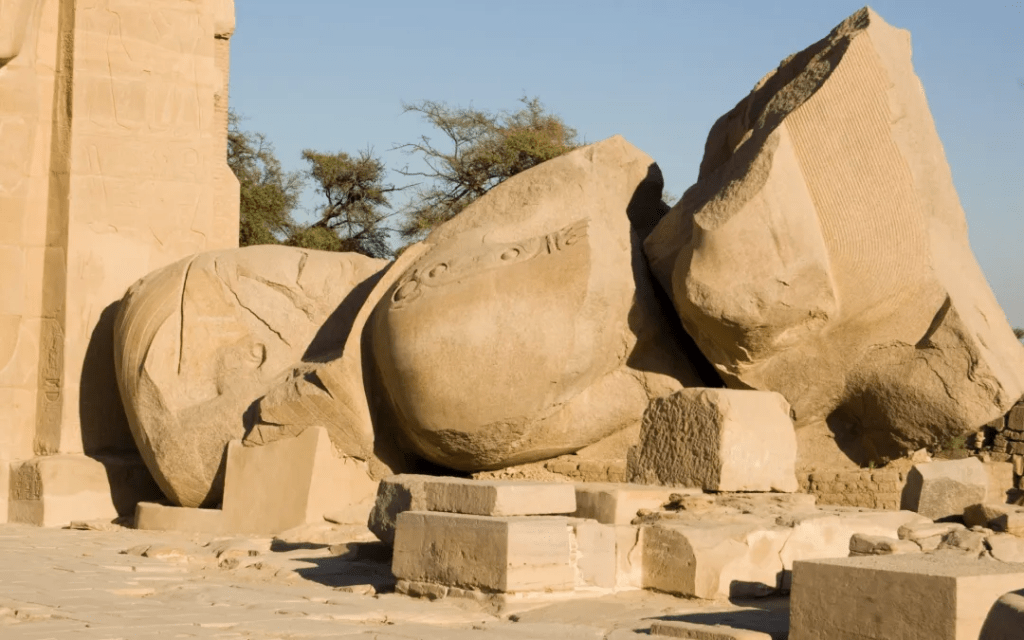
The museum’s final curator, before fleeing with the rest, swore the photograph would sometimes whisper at night, in a voice like wind through ruins: “Look on my Works, ye Mighty, and despair!” Some nights, the whispers would grow into conversations, as though the photograph was arguing with itself about the nature of permanence.

In the weeks before the museum’s abandonment, visitors reported strange phenomena. The photograph seemed to weep on Tuesdays, though the tears turned to dust before reaching the floor. On Fridays, it would emit a sound like distant laughter, though whether of joy or madness none could say. Children claimed they could see butterflies emerging from the fading ink of the unsigned treaties.

But the story doesn’t end there, for where their images faded, something else began to appear. First came the ghostly outlines of demolished statues, then the shadows of toppled monuments. But these too faded, making way for something far more substantial: Children playing in streets once blocked by tanks. Women spoke in voices that had been silenced for generations. Men embracing neighbors they’d been taught to fear. The photograph, like history itself, was being rewritten.

The transformation continued, defying all known laws of photography and physics. The ornate chairs crumbled into garden soil. The unsigned treaties bloomed into flowers. The blank walls behind became windows opening onto possibilities that had always existed but had never been permitted to be seen.

Now, in place of two tyrants’ frozen smiles, there blooms a garden of faces – countless, ordinary, extraordinary faces of people who had always been there, waiting in the shadows of statues that thought themselves eternal. Their images grow clearer with each passing day, as though the photograph is learning to tell a different kind of truth. Each face bears a story that was always worth telling but had been deemed too simple for official histories: a grandmother’s recipe for courage, a student’s theorem proving the mathematics of hope, a farmer’s almanac predicting seasons of change.

And if you listen carefully, in the quiet hours when museums dream, you might hear a new whisper, carried on the same wind that once spoke of despair: “Look on our works, ye mighty, and hope.” The whisper grows stronger with each passing day, as though the very air is remembering how to carry voices that speak without permission or fear.

For in the end, it is not in marble halls or gilded thrones, or some gladiator stadium, that power truly resides, but in the persistent, defiant bloom of human dignity – the one force that no dynasty, no matter how fearsome, has ever managed to outlast. The photograph hangs there still, in a museum that no longer exists, telling its endless story to anyone who dares to look long enough to see themselves reflected in its changing surface.

And sometimes, on very quiet mornings, visitors swear they can hear the sound of distant wings, as though all the butterflies of history are taking flight at once.

The Time Merchants of Ihled

In a country not much like our own, the people discovered they could no longer afford to buy the present. The cost had grown too high—basic necessities, dreams, and futures were all priced beyond reach. So, instead, they began trading in the past.

The Time Merchants’ Exchange opened its doors in the capital city, a towering edifice of marble and mirrors where every reflection showed a different decade. Here, politicians could purchase vintage grievances at premium rates, while selling ancestral glories at even higher markups. The most valuable commodity was blame, especially if it was well-aged, preferably several centuries, if not decades, old.

Young Kumar visited this exchange one day, his pockets empty of present opportunities but his mind full of past questions. His engineering degree, fresh and useless as tomorrow’s newspaper, weighed heavily in his worn backpack. He watched as the country’s leaders engaged in fierce bidding wars over sepia-toned accusations and black-and-white responsibilities.

“How much for a job?” he asked a broker, a portly man whose suit was stitched from threads of old speeches.

“Jobs? Oh, we don’t deal in those anymore,” the broker laughed, his belly shaking like tomorrow’s earthquake. “But I can offer you a lovely argument about economic policies from the 1950s. Guaranteed to keep you distracted for weeks! Very popular these days.”

“What about affordable housing?”

“Have you considered instead this fascinating debate about who built which institution seventy years ago? It comes with a complementary set of grievances and a lifetime supply of blame!”

In the gallery above, two groups of traders were locked in an eternal auction, bidding higher and higher on who could claim the greater share of historical grievances. Their voices echoed through the marble halls while the present gathered dust outside. The traders wore special glasses that only allowed them to see backward, never forward, and certainly never at the now and present.

Kumar noticed an old woman sweeping the exchange floor. She was gathering up discarded presents and futures that people had traded in for past grievances. “Such waste,” she muttered, picking up a child’s dream of becoming a scientist, slightly used but still functional.

But something strange began to happen. The youth, led by Kumar and others like him, started opening their own exchange—they called it Tomorrow’s Market. They traded in hope, innovation, and solutions. They bartered in ideas and possibilities. Their currency was creativity, their capital was courage, and their profit was progress.

When the Time Merchants tried to shut them down, claiming exclusive rights to all temporal transactions, they simply moved their trading to parks, to street corners, to social media. They set up shop under bridges and in abandoned warehouses, in college canteens and quiet libraries.

“The past is a good teacher,” Kumar declared at one such gathering, watching as young people exchanged ideas like precious gems, “but it makes a poor home. We cannot live there forever. And while some spend their days auctioning off blame for yesterday’s problems, we’ll be too busy building tomorrow to attend the bidding.”

The Tomorrow’s Market grew. People traded solutions for water scarcity, exchanged ideas for clean energy, bartered plans for better education. They even opened a special counter where communal harmony could be freely exchanged, much to the horror of those who had invested heavily in division.

The Time Merchants were horrified to discover their carefully curated vintage blame was rapidly losing value. Their prized collections of historical grudges began gathering dust. People were more interested in trading futures than pasts. Some even suggested that the present moment, that long-neglected commodity, might be worth investing in again.

The old woman with her broom smiled as she watched young people rushing past the Exchange, heading to Tomorrow’s Market. She had been gathering discarded dreams for years, waiting for someone to reclaim them. Now, finally, she could return them to circulation.

In the end, the Time Merchants’ Exchange still stands, and its marble halls still echo ancient debates. Inside, a dwindling group of traders continues to bid on bygone eras, their voices growing fainter each day. But more and more people pass it by, heading instead to the bustling markets of tomorrow, where hope trades at premium rates, and the future is always in stock.

And sometimes, if you listen carefully in the quiet hours, you can hear the sound of the present, ticking away like a clock in an empty room, waiting for someone to remember it exists.